Sunday, August 30, 2009

Wakatobi..the next paradise in Indonesia


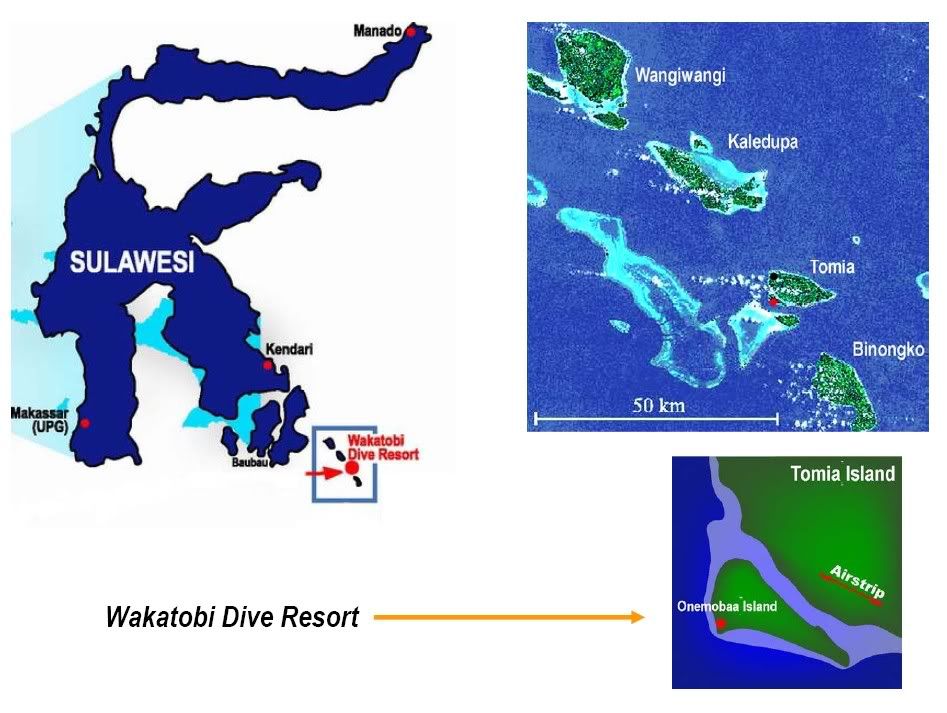
Wakatobi Island, an area located in the Banda Sea area of Southeast Sulawesi is a tourist destination which was fantastic as a diving and tourism attractions that  Indonesia Sea have.
Miracle Sea Bottom and the best coral reefs in the world makes Wakatobi as one tourist destination (especially diving tourism) which you must visit for you lovers of Diving.

Wakatobi Resort offers world-class diving is supported by a spectacular house reef as well as easy access to dive sites with a diversity of marine life coupled with the security and convenience in conducting activities that are guaranteed diving with marine protected areas.

Wakatobi Resort also has a staff of experienced and knowledgeable in tourism services, serving healthy food menu and variety of taste, and equipped with satellite communication device with Internet access 24 hours, so the Wakatobi Dive Resort, serving the guests with world standards of service.

The resort is also equipped with an airfield on the island Maranggo Tomia with a flight path that connects the island of Bali to Tomia will make the trip to Wakatobi mudan and comfortable.
 Wakatobi Accomodations

Wakatobi offers beautiful accommodations with fine appointments that will satisfy the most discriminating traveler!

There are four (4) levels of accommodation: Villas, Select Beach Bungalows, Standard Beach Bungalows and Garden Bungalows.

All accommodations are spacious and available with a either a king-size bed, and/or twin beds to sleep up to three adults or two adults and two children. All of our accommodations have a balcony in front as well as lounge chairs, tables and other furnishings. There a desk with internet access, a mini-bar, and much more. All bungalows and villas are equipped with airconditioning.


Tuesday, May 5, 2009

Traditional Dance(1)

 There are lots of traditional dances (tari) in Indonesia, thanks to many different ethic groups in its 27 provinces. Usually, each province has its own youth dance, war dance and greeting dance. All which were developed long before Indonesia became one country on August 17, 1945. We have collected a couple popular dances from each province. And you are sure to find much more when you actually visit Indonesia.
the first one came from Sumatra region
Sumateranese dances
1. Northern Sumatera's Tor Tor
2. Aceh's Serampang Duabelas
3. Jambi's Sekapur Sirih
4. Riau Isles' Joget Lambak
5. Western Sumatera's Tari Piring
6. Southern Sumatera's Puteri Bekhusek
7. Bengkulu's Andun
8. Lampung's Jangget

Aceh

Tari Seudati:

Danced by 8 men and 1-2 other narrators and led by a sheh (dance leader). It doesn't need any musical instruments. The dance describes heroic characteristics of Acehnese.

Tari Saman (for men) and Meusekat (for women):

Developed from the traditional dance "Tepuk Ane" and played by 8-20 dancers. They kneel in a row on the floor or the ground and make many kinds of torso movements. It starts with a very slow speed which gradually becomes a rapid speed then stop suddenly. Accompanied by songs while clapping hands, slapping the chest, slapping hands on the floor.

Tari Rapa-ii Geleng:

It is a specific tambourine used in dancing and singing. Has 11-20 men dancers, similar to Saman.
 

North Sumatra
 
Tari Manduda:

Traditional dance of Simalungunese, portraying the people who are excited during

 
Tari Sekapur Sirih:

This is danced to greet guests who are visiting North Sumatra.

 
Tari Baluse:

A Nia warrior dance which shows brevity and courage
 

West Sumatra
 
Tari Piring:
This dance is uses plates with candles on top as one of the accessories. Dancers skilfully move their hands with the plates and candles in them. This dance symbolizes the tight and co-ordinated Minangkabau people.
 

Riau
Joget Lambak:

The dance is one of the means of socializing between young girls and guys.

 
Tari Tandak Riau:

This is also one of the social dances in Riau
 

Jambi

Tari Rangguk:

Full spirited dance, especially performed to greet some guests.

Tari Selampit Delapan:

A social dance for the teenage girls and boys

 
Tari Sekapur Sirih:

This dance differs from North Sumatran dance only in costumes and origin, but both of them serve as entertaining dances.
 

Lampung

Tari Jangget:

This is a special dance which is performed during traditional ceremonies. It portrays the morals of the people of Lampung.

 
Tari Melinting:

A dance that carries a legend. When Sunan Gunung Jati (one of the Nine Islam Sheikhs in Indonesia) visited the Kingdom of Pugung, he fell in love with Putri Sinar Alam--the princess--who was supposedly performing Tarin Melinting.

Tari Bedana:

A social dance with Islam influence
 

South Sumatra
Tari Kipas:

A social dance for teenage girls and boys of South Sumatra
 
Tari Tanggai:

A special dance to greet the guests of South Sumatra. All of the dancers have fake long gold nails as one of their accessories.
 

Bengkulu
Tari Bidadaei Terminang Anak:

It means a dance for a fairy who is cuddling a baby. This a traditional dance of Rejanglebong
 
Tari Andun:

This dance originated from the south of Bengkulu. It is a special dance to greet guests of honour.
  

Mekarsari Fruit park


Mekarsari Tourism Park is the center of the tropical fruitiest in Indonesia. It is the largest tropical fruitiest in the world in the area of 264 hectar. it was built in 1990 . The park located in Cileungsi, District of Bogor West Java an can be accessed from Jakarta only about 1 hour. 
The garden of Wisata Mekar Sari was one of the centres of conservation of the biological diversity of the biggest tropics fruit in the world, especially the superior fruit kind that was gathered from all over the area in Indonesia, at the same time being the place of the cultivation research (agronomy), breeding (breeding) and the increase in the prime seed to afterwards be spread to the farmer and the public's community.  
Park facilities are comfortable, made up of several zones, among others, Water Zone, Family Zone, Race Point, Exotic Mediterranean zone, Central Park, the land and the Green Zone. Diversity of plants into one of the benefits of Mekarsari compared to other parks. We can do various activities such as the view from near the fruit-the fruit of native Indonesia; see the orchard that we rarely see, and so forth. Garden area of 264 hectares is equipped with facilities for tourists touring the archipelago and abroad. Tourism in the middle of the park is supported by various vehicles that visitors to the natural approach. Visitor can look many types of activities and park like • Family Garden, • Recreation Lake (20 ha), • Baby Zoo, • Deer spotted, • Garden Center, • Greenhouse Melon, • Outbound, • dead flowers, • Kids Fun Valley, • Scenic Tower • Building Water Fall (Tirto Sari Puri). • Gathering Company, • Family picnic, • Tourism Fruit Garden • Barbeque, • Walking in the garden. 
Beside the draught with various trees that if again the fruitful season could be at once reaped and in ate in the place, this tourist attraction was also supplemented with other tour means like, the circle carriage, the tour car, tuk-tuk, the bicycle tandem, the motor atv, monorail, the duck boat, the rowing-boat, bombom car, the flora theatre, the water lily pond, the water garden, the canal boat, the centre of seedling cultivation, the shop, the shop souvenir the fruit, pujasera, Vila in the orchard forest, the entertainment stage and did not miss also challenge facilities outbound that really defiant as flying slid, descended steep, climbing the rope, went on the rope, climbed askew bamboo and all the rest.
Lately, to attact more visitors they improve fascinating tourism activities at Mekarsari through diversification of thematic and adventurous products such as: Environment Gathering, Eco-Schooling etc.


Monday, April 27, 2009

The Three Coloured Lake Kelimutu

Lake kelimutu, part of kelimutu national park, is situated on the peak of mount kelimutu which is at an altitude of 1.631 meters.administratively located in the district of Ende, East Nusa Tenggara Province.

Kelimutu is a volcano, close to the town of Moni in central Flores Island of Indonesia containing three summit crater lakes of varying colors. Tiwu Ata Mbupu (Lake of Old People) is usually blue and is the westernmost of the three lakes. The other two lakes, Tiwu Nuwa Muri Koo Fai (Lake of Young Men and Maidens) and Tiwu Ata Polo (Bewitched or Enchanted Lake) are separated by a shared crater wall and are typically green or red in color, respectively. The lake colors do vary on a periodic basis. Subaqueous fumaroles are the probable cause of active upwelling that occurs at the two eastern lakes.
The lake have been a source of minor phreatic eruptions in historical time. The summit of the compound 1639-m-high Kelimutu volcano is elongated two km in a WNW-ESE direction; the older cones of Kelido and Kelibara are located respectively three km to the north and two km to the south. The scenic lakes are a popular tourist destination. Keli Mutu is also of interest to geologists because the three lakes are different colors yet reside at the crest of the same volcano

there are three bacwaters in the lake which tend to turn their colours. for instance the water in oone of those , change fro red to bottle green then someday it can be pink and in another backwater , the water turn from bottle green into light green, the last one , the water can change from deep brown into azure.
Although the guidebooks all talk about being up on the summit for sunrise, you should do that only if you're a fan of sunrises. The lakes do not show their glory until the sun hits them, which will be about 8 or 9 in the morning, depending on the lake.

it can accessed by taking air transportation from kupang, the capital of east nusa tenggara province, to ende district, it will be approximately 40 minutes,The closest airports are Maumere, and Ende. There are regular flights to Maumere from Bali. continue the journey by public transportations to kaonara village, about 93 km away or 3 hous, then continued by walk for around 2.5 km. entrance ticket is IDR 3000, on the weekend the ticket will be IDR 5000. Moni is a small settlement at the foot of the volcanic Mount Kelimutu on the island of Flores in Indonesia. It is a good base for a trip to the coloured lakes of the volcano. The drive from Maumere to Moni, the town at the base of Keli Mutu, takes about 3 hours.

Jopu Traditional Hand Weaving Villages

Ikats weaving is one of the most attractive to see in the area of Moni, Take a walk to Jopu villages where you can see how the process of Ikat weaving.
Along the routes between Moni and Jopu is the most beautiful view on the area, take walk all the way to Jopu and on the way back take a bus ride from Jopu to Moni.


Green Canyon Pangandaran

Green Canyon real name is Cukang Taneuh, located in the Village Kertayasa District Cijulang, ± 31 km from Pangandaran. This tourism object is a river Cijulang that penetrate caves stalaktif with the glamor and stalaknit and diapit by two hills with rocks and trees rimbunnya natural attraction that presents the unique and challenging.

At the mouth of the cave there is a waterfall Palatar objects in the atmosphere so this tour is so cool. Activities that can be made of them rock climbing (rock climbing), swimming, canoe while fishing.

To reach the location of this tourist boat that can use widely available in Central Ciseureuh,  both  boat and paddle boats. 

The canyon is apparently a couple of hundred metres long, but it is only safe for visitors to venture the first hundred, so that's as far as the guide takes the group. You are swimming against the current going in, so that and the fact that you're always wanting to stop and look up in wonder makes the going a little difficult. Still, you make it half way and have the opportunity to jump from a 5 metre high stalagmite formation rising from the canyon floor into a deep pool below. The rocks aren't sharp or slippery and there's a myriad of harmless critters around like frogs, dragonflies and miniature crabs to marvel at too. Keep going as far as you can and once you reach the end, float all the way back down to see it again at a leisurely pace. Nice!
This tourism object near the object degan tour Batukaras and Flying Field Nusawiru.


Sunday, April 26, 2009

Nusantara "Symphonie" Tourist Bus

NusantaraTourist Bus

Nusantara is a the tourist buses premium service that concern to comfort and safety for its passengers. Supported by the latest technology, the bus fleet with the latest graphic design that is attractive advantages us.

Equipped with GPS (Global Positioning System), AC, CD, VCD, DVD, toilet, full reclining seat with foot rest, individual reading lights, AC and louver additional attributes for your comfort and safety.


one of their triumph is to serve on the front of Asia Africa Conference in April 2005.

For more information and reservations, contact:
Jl. No Getas Pejaten. 4, Kudus - Central Java
Phone: 0291-438 635
Fax: 0291-433 133

Jl. Raya Kudus - Demak Km. 5, Karanganyar - Demak
Phone: 0291-435 406
Fax: 0291-446 407

Jl. Daan Mogot No. 3P / The Pom Bensin House, West Jakarta
Phone: 021-5694 0652, 021-5694 0653, 021-569 1717
Fax: 021-564 2993

Wednesday, April 22, 2009

Raja Ampat


Raja Ampat casts a spell on all who visit – scientists, photographers, novice divers and crusty sea-salts alike. This group of majestic islands, located in the northwestern tip of Indonesia’s Papuan “Bird’s Head Seascape,” lies in the heart of the coral triangle, the most bio-diverse marine region on earth.

As stunningly beautiful above water as it is below, Raja Ampat (which literally translates as “The Four Kings”) has a startling diversity of habitats to explore. Each of these – from the stark wave-pounded slopes that drop away beneath the karst cliffs of Wayag and Uranie to the deep, nutrient-rich bays of Mayalibit, Kabui and Aljui to the “blue water mangrove” channels of Kofiau and Gam to the plankton-rich upwelling areas of Misool and the Dampier Strait – are home to unique assemblages of species that, when taken together, add to produce the most impressive species lists ever compiled for a coral reef system of this size.

Marine tourism, as a sustainable alternative to overfishing, mining, and logging, has the potential to play a key role in the conservation of Raja Ampat’s spectacular underwater realm, while also creating real benefits for the local communities. This website was designed as part of a larger effort to support the growth of sustainable marine tourism in Raja Ampat and the conservation of these magical islands.

Raja Ampat is all about diversity - not only diversity of species, but also of dive sites. There are some areas where soft corals and sea fans dominate, others with amazing diverse hard corals, seagrass beds, mangroves, shallow reefs, drop offs, caves, black sand, white sand…Then there are the fish, lots of them, in more shapes and sizes than anywhere else in the world. Not only are there loads of fish, but all the levels of the food chain are well represented – from pygmy seahorses to top predators. In many places brightly colored soft corals can be found close to the surface which, illuminated by natural sunlight, make these dive sites spectacularly colorful. The reefs in Raja Ampat just buzz with life!

Where to dive

Raja Ampat is huge, 50,000 sq km, with hundreds of islands and an astounding diversity of habitats, which translates to wildly different diving experiences from pelagic drift dives to magic muck dives and even some habitats that are special to Raja Ampat such as clear water mangroves with corals growing right next to them! There are thousands of potential dive sites. Exploration is still continuing, and on every trip there are chances for new and amazing discoveries. Even on a 12 day trip you will only have a chance to see some of what Raja Ampat has to offer. 

The easiest way to get to Raja Ampat is to fly to Sorong via Jakarta or Singapore. Domestic travelers can also fly via Makassar or Manado.

From Jakarta or Bali: Merpati, Express Air and Lion/Wings operate daily flights from Jakarta to Sorong (with stopovers in Ujung Pandang/Makassar and/or Manado)

From Singapore: Silkair operates regular flights from Singapore to Manado. From Manado to Sorong regular flights are offered by Lion Air and Merpati.
It is easiest to check with a local Indonesian Travel agent or directly with the airline for the lastest domestic flights available.


Ciater Hot Spring


Ciater Hot Spring is a nice park with small pools in which we can sit or swim. The streams and pools are fed by warm mineral springs, which are created by the heat from nearby volcanoes. About 30 minutes from Tangkuban Perahu crater. Ciater is pretty little place in the middle of huge tea estate. Its main attraction is the Sari Ater Hot Spring Resort; the pools are probably the best of all the hot springs around Bandung.

We can enjoy swimming in warm sulfurous water pools that can heal rheumatism and skin problems. Here we can swim in warm mineral water pools, good for healing skin problems. Ciater hot spring is one stop place for entertainment and relaxation. Ciater is located in Lembang, a green, lush place. The water contains iodium and sulfur, well for curing skin ailments and rheumatism. Equipped with tennis courts, restaurants, and camping area, Ciater is a good way to retreat from every day's life.

The water temperatur of 450 C cools down to 400 C - 420 C, after is allowed to flow through the pipes of the bathrooms in the hotels. The village of Ciater is well know for its natural hot spring, the source of sulphuric water which is reputable for its efficacy to cure various disease like paralysis, remathism, nerve and bone diseases and other skin diseases under consultation and supervision of doctor specialist. The water shich flows through the river of 2.000 meters long becomes cold and is used by the people in the community to irrigated their rice fields. It is said that this water helps to improve the quality of harvest.


Ciater is another area with tea plantations and hot springs, eight km northeast of Tangkuban Perahu. The place also has a tea factory. Ciater is a good starting point for hiking, and has some accommodation.


Tuesday, April 21, 2009

Batik(3)

This is a few of batik design

Batik Designs

Although there are thousands of different batik designs, particular designs have traditionally been associated with traditional festivals and specific religious ceremonies. Previously, it was thought that certain cloth had mystical powers to ward off ill fortune, while other pieces could bring good luck.Wedding Batik

Certain batik designs are reserved for brides and bridegrooms as well as their families. Other designs are reserved for the Sultan and his family or their attendants. A person's rank could be determined by the pattern of the batik he/she wore.

In general, there are two categories of batik design: geometric motifs (which tend to be the earlier designs) and free form designs, which are based on stylized patterns of natural forms or imitations of a woven texture. Nitik is the most famous design illustrating this effect.

Certain areas are known for a predominance of certain designs. Central Javanese designs are influenced by traditional patterns and colors. Batik from the north coast of Java, near Pekalongan and Cirebon, have been greatly influenced by Chinese culture and effect brighter colors and more intricate flower and cloud designs.

High fashion designs drawn on silk are very popular with wealthy Indonesians. These exceptionally high-quality pieces can take months to create and costs hundreds of dollars.

Kawung

Kawung DesignKawung is another very old design consisting of intersecting circles, known in Java since at least the thirteenth century. This design has appeared carved into the walls of many temples throughout Java such as Prambanan near Jogjakarta and Kediri in East Java. For many years, this pattern was reserved for the royal court of the Sultan of Jogjakarta. The circles are sometimes embellished inside with two or more small crosses or other ornaments such as intersecting lines or dots. It has been suggested that the ovals might represent flora such as the fruit of the kapok (silk cotton) tree or the aren (sugar palm).

Ceplok

Ceplok DesignCeplok is a general name for a whole series of geometric designs based on squares, rhombs, circles, stars, etc. Although fundamentally geometric, ceplok can also represent abstractions and stylization of flowers, buds, seeds and even animals.

Variations in color intensity can create illusions of depth and the overall effect is not unlike medallion patterns seen on Turkish tribal rugs. The Indonesian population is largely Muslim, a religion that forbids the portrayal of animal and human forms in a realistic manner. To get around this prohibition, the batik worker does not attempt to express this matter in a realistic form. A single element of the form is chosen and then that element is repeated again and again in the pattern.

Parang

Parang DesignParang was once used exclusively by the royal courts of Central Java. It has several suggested meanings such as 'rugged rock', 'knife pattern' or 'broken blade'.

The Parang design consists of slanting rows of thick knife-like segments running in parallel diagonal bands. Parang usually alternated with narrower bands in a darker contrasting color. These darker bands contain another design element, a line of lozenge-shaped motifs call mlinjon. There are many variations of this basic striped pattern with its elegant sweeping lines, with over forty parang designs recorded. The most famous is the 'Parang Rusak' which in its most classical form consisting of rows of softly folded parang. This motif also appears in media other than batik, including woodcarving and as ornamentation on gamelan musical instruments.

Washing Batik

Harsh chemical detergents, dryers and drying of fabrics in the sun may fade the colors in batik. Traditionally dyed batiks should be washed in soap for sensitive fabrics, such as Woolite, Silky or Halus. Fine batik in Indonesia is washed with the lerak fruit which can be purchased at most traditional markets. A bottled version of this detergent is also available at batik stores. Be sure to line dry batik in a shady area and not in direct sunlight.

Modern Batik

Modern batik, although having strong ties to traditional batik, utilizes linear treatment of leaves, flowers and birds. These batiks tend to be more dependent on the dictates of the designer rather than the stiff guidelines that have guided traditional craftsmen. This is also apparent in the use of color that modern designers use. Artisans are no Modern Batiklonger dependent on traditional (natural) dyes, as chemical dyes can produce any color that they wish to achieve. Modern batik still utilizes canting and cap to create intricate designs.

Fashion designers such as Iwan Tirta have aggressively introduced batik into the world fashion scene. They have done much to promote the Indonesian art of batik dress, in its traditional and modern forms.

The horizon of batik is continuing to widen. While the design process has remained basically the same over the last century, the process shows great progress in recent decades. Traditionally, batik was sold in 2 1/4 meter lengths used for kain panjang or sarong in traditional dress. Now, not only is batik used as a material to clothe the human body, its uses also include furnishing fabrics, heavy canvas wall hangings, tablecloths and household accessories. Batik techniques are used by famous artists to create batik paintings which grace many homes and offices.

Fine quality handmade batik is very expensive and the production of such works is very limited. However, in a Modern Batikworld that is dominated by machines there is an increasing interest in materials that have been handmade. Batik is one of these materials.

During your stay in Indonesia, take advantage of your time here to learn more about the fascinating world of batik. Have a batik dress or men's business shirt made for you by a seamstress or tailor. Visit batik factories in Jogjakarta, Surakarta or Pekalongan to see for yourself how the intricate process is conducted or ask questions of batik artisans giving demonstrations in stores such as Sarinah or Pasaraya in Jakarta. You will come away with sense of wonder over the time, effort and patience put into the creation of each batik cloth. You too may soon grow to love the distinctive waxy smell of batik and your batik acquisitions will provide many memories of your stay in Indonesia. Your support of the batik industry will also ensure that this art form grows to even greater peaks.